
 |
| Ancient Near East Educational Materials |
|---|
| www.studenthandouts.com ↣ World History Teaching Materials ↣ Ancient Near East Educational Resources |
Life in the ancient Near East was characterized by a rich tapestry of cultures, civilizations, and historical periods, spanning thousands of years and encompassing diverse regions. While conditions varied depending on time and place, here are some common aspects of life in the ancient Near East. Our free educational materuals are designed to assist teachers covering the ancient Near East in World History classes.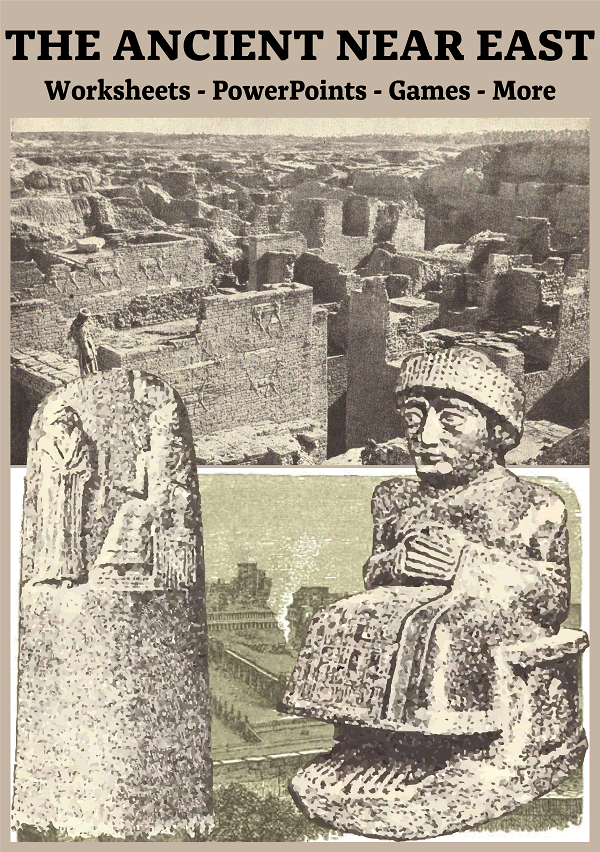 Agriculture: Agriculture played a central role in the economies of many ancient Near Eastern civilizations. People cultivated crops such as wheat, barley, millet, and various fruits and vegetables. Irrigation systems were often developed to manage water resources in arid regions.
City-States: Urbanization was a hallmark of the ancient Near East. City-states, with their own governments and rulers, emerged as centers of political, economic, and cultural activity. Prominent city-states included Uruk, Ur, Babylon, Nineveh, and Ashur, among others. Trade and Commerce: The ancient Near East was a hub of trade, facilitated by its geographic location between Asia, Africa, and Europe. Trade routes like the Silk Road connected distant regions, leading to the exchange of goods, ideas, and technologies. Religion: Religion played a central role in the lives of ancient Near Eastern people. Many civilizations in the region had pantheons of gods and goddesses, and temples were important religious and cultural centers. Prominent religions included Mesopotamian polytheism, Egyptian religion, and the worship of various gods and goddesses in the Levant. Writing Systems: Writing systems developed independently in different parts of the ancient Near East. Notable scripts included cuneiform (used in Mesopotamia), hieroglyphics (in Egypt), and the Proto-Sinaitic script (an early precursor to the alphabet). These scripts were used for record-keeping, literature, and religious texts. Monuments and Architecture: The ancient Near East is known for its impressive architectural achievements, including ziggurats (stepped pyramids), temples, palaces, and city walls. These structures served both practical and religious purposes. Social Hierarchy: Society in the ancient Near East was typically hierarchical, with rulers, nobles, priests, and a laboring class. Slavery was common in many civilizations, and social mobility was often limited. Law Codes: Some of the earliest known legal codes were established in the ancient Near East. Notable examples include the Code of Hammurabi in Babylon and the Hittite laws. These codes codified rules of behavior and justice. Art and Culture: The ancient Near East produced a rich cultural heritage, including art, literature, and music. Examples include Sumerian cuneiform literature, Egyptian hieroglyphic inscriptions, and Babylonian mathematics. Conflicts and Empires: The region experienced periods of conflict and the rise and fall of various empires, including the Akkadian Empire, Assyrian Empire, Babylonian Empire, Persian Empire, and Egyptian dynasties. These empires often vied for control of territory and resources. Innovations: The ancient Near East was home to numerous innovations, including the wheel, the plow, the calendar, and advancements in mathematics, astronomy, and medicine. Migrations and Interactions: The movement of peoples and the interactions between different cultures were significant features of life in the ancient Near East. This led to the diffusion of ideas, technologies, and cultural practices. It is important for educators to hold in mind that the ancient Near East was a region of great diversity, and life varied considerably over time and across different civilizations. The region's history includes the rise and fall of powerful empires, the development of complex societies, and the contributions of these ancient cultures to the foundations of human civilization. We know that our free teaching materials--including printables, puzzles, outlines, PowerPoints, worksheets, maps, pictures, DBQs, and more--will aid you and your high school students' exploration of this fascinating subject in your World History class. Meanwhile, life in ancient Israel was shaped by a combination of geographical, historical, and religious factors. The region of ancient Israel, located in the eastern Mediterranean, played a central role in the development of monotheistic religions, including Judaism, Christianity, and Islam. Here are some key aspects of life in ancient Israel.  Geography: Ancient Israel was situated in the Levant, a region known for its diverse landscapes, including coastal plains, fertile valleys, arid deserts, and mountainous terrain. The Jordan River and the Sea of Galilee were significant geographical features.
Agriculture: Agriculture was the primary occupation for most ancient Israelites. They cultivated crops such as wheat, barley, grapes, olives, and figs. Terracing was used to make hilly terrain suitable for farming. Religion: Ancient Israel was the birthplace of monotheism--the belief in one god (Yahweh). The Israelites followed the monotheistic religion of Judaism, with a central focus on the worship of Yahweh (the god of Abraham). Religious life included rituals, sacrifices, and adherence to the Torah (the Jewish sacred text). Family and Social Structure: The family was the basic unit of society. It was patriarchal, with the eldest male as the head of the household. Families were organized into clans, tribes, and, according to biblical tradition, the twelve tribes of Israel. Law and Justice: The Israelites followed a legal system based on religious principles. The Torah contained the Ten Commandments and a comprehensive legal code. Judges and elders administered justice at local levels. Kingship: At various points in its history, ancient Israel was ruled by kings, beginning with King Saul and continuing with King David and King Solomon. The period of the monarchy marked a transition from a tribal confederation to a centralized kingdom. Prophets: Prophets played a significant role in ancient Israelite society. They were religious leaders and moral guides who conveyed Yahweh's messages and often challenged the rulers and society to uphold justice and righteousness. Trade and Commerce: Israel's location at the crossroads of trade routes facilitated commerce with neighboring regions, including Egypt, Mesopotamia, and the Mediterranean world. Trade was essential for acquiring goods not locally available. Cultural Expressions: Ancient Israel produced religious texts, poetry, and historical narratives, such as the Psalms, the Book of Proverbs, and the historical books of the Hebrew Bible (Old Testament). Foreign Rule: Over the centuries, ancient Israel experienced foreign rule and conquest by various empires, including the Assyrians, Babylonians, Persians, Greeks, and Romans. These periods of foreign domination brought changes to political, cultural, and religious life. Diaspora: The dispersion of Jewish communities outside the homeland, known as the Jewish diaspora, began with the Babylonian exile and continued through subsequent centuries. Jewish communities formed in different parts of the world, maintaining their religious and cultural identity. Conflict and Wars: Ancient Israel was frequently involved in conflicts with neighboring peoples, including the Philistines, Canaanites, and various Mesopotamian empires. These conflicts often had religious and territorial dimensions. Synagogue and Temple: Religious worship took place in synagogues and, during certain periods, in the First and Second Temples in Jerusalem. The Temple was a central religious and cultural institution. Life in ancient Israel was deeply influenced by its religious beliefs, agricultural practices, and interactions with neighboring cultures. It was a society with a rich literary and religious heritage that continues to influence world history and culture to this day through the legacy of Judaism and its contributions to the development of Christianity and Islam. |
| www.studenthandouts.com ↣ World History Teaching Materials ↣ Ancient Near East Educational Resources |